Modern businesses run on always-on technology: servers, networks, security systems, and cloud-connected applications. A single power disturbance can mean downtime, data loss, or damaged equipment. In 2026, those risks are only growing as more workloads move to the edge, more users work remotely, and more services must be available 24/7.
That's why backup power has become non-negotiable in IT and facilities planning. But here's where too many organizations make a costly mistake: they treat UPS systems and battery backups as interchangeable terms. They're not, and the difference matters more than ever.
UPS Systems vs. Battery Backups: Understanding the Core Difference
At a high level, both solutions serve the same fundamental purpose: providing power when the primary source fails. But the depth of protection each delivers is not comparable.
A UPS system (uninterruptible power supply) is designed to continuously condition and regulate incoming electricity. It protects connected equipment even when utility power is technically "on." Voltage sags, spikes, and transient disturbances happen constantly and silently, and a UPS addresses all of them in real time. Power quality events are among the most underreported challenges in data centre operations, and their impact compounds over time.
A battery backup is a reactive device. It stores energy and discharges it during outages. That's it. It does little to address the power quality issues that occur outside of full blackouts, issues that are increasingly common as power grids face higher variability and strain.
The old saying still holds true, and it's more relevant than ever: a UPS is a battery backup, but a battery backup is not a UPS.
Why Sine Wave Technology Is Non-Negotiable for Critical Loads
This is one of the most overlooked distinctions in the UPS vs. battery backup conversation, and one of the most consequential.
Pure sine wave output mirrors the smooth, consistent waveform delivered by utility power. Enterprise servers, medical equipment, HVAC systems with variable-speed drives, and most modern electronics are designed to run on pure sine wave power. Anything less introduces risk.
Many battery backups produce simulated (modified) sine wave output, a stepped approximation that can cause equipment to run hotter, behave erratically, or fail prematurely. For non-critical devices like a desk lamp, that may be acceptable. For a server rack, a healthcare monitoring system, or a network switch supporting hundreds of users, it is not.
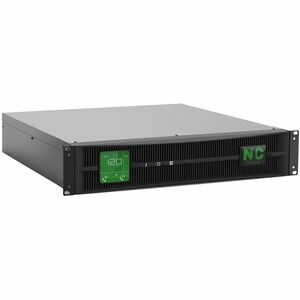
N1C's lithium-ion UPS systems deliver pure sine wave output as standard, because protecting critical infrastructure means protecting it completely, not partially.
Cost Comparison: Upfront Price vs. Total Cost of Ownership
Battery backups carry a lower upfront price tag. That's the extent of their financial advantage.
When you factor in total cost of ownership (TCO), the math shifts decisively:
UPS System
- Upfront investment: Higher
- Battery replacement frequency: Less frequent (lithium-ion)
- Maintenance requirements: Predictive / minimal
- Equipment damage from power events: Mitigated
- Downtime cost exposure: Minimized
- Design life: Up to 15 years
Battery Backup
- Upfront investment: Lower
- Battery replacement frequency: More frequent (lead-acid)
- Maintenance requirements: Reactive / manual
- Equipment damage from power events: Unmitigated
- Downtime cost exposure: Significant
N1C's lithium-ion UPS systems carry a 10-year warranty and a 15-year design life, with less than a 1% warranty claim rate. That's not a marketing claim. That's a track record. When you stop replacing batteries every few years and stop absorbing the cost of unplanned downtime, the investment calculates itself.
Use Cases: Which Solution Fits Your Facility?
When a UPS System Is the Right Answer
- Data centers and server rooms: Any environment where uptime and data integrity are operational requirements, not aspirations
- Healthcare facilities: Patient monitoring equipment, imaging systems, and life-critical infrastructure cannot tolerate power anomalies
- Manufacturing and industrial operations: Automation platforms and PLCs are highly sensitive to voltage irregularities
- Retail and financial services: Point-of-sale systems, transaction processing, and customer-facing technology demand uninterrupted operation
- Government and critical infrastructure: Regulatory compliance and continuity requirements make UPS systems the only defensible choice
When a Battery Backup May Suffice
- Home office workstations used for non-critical tasks
- Personal computing devices where a brief shutdown window is acceptable
- Low-risk scenarios where the only need is a graceful shutdown, not true continuity
If your facility is in the first list, a battery backup is not a solution. It's a liability.
Advanced Features Are the New Baseline
In 2026, monitoring, remote visibility, and system intelligence are standard expectations, not premium upgrades.
Modern UPS systems deliver:
- Real-time load and battery health monitoring
- Remote diagnostics and alerting
- Predictive maintenance capabilities that help organizations anticipate failures before they occur
- Generator integration for extended runtime during prolonged outages
Battery backups remain largely opaque. Users often have no visibility into battery condition or expected performance until an outage reveals the answer at the worst possible moment. For a deeper look at why data centers specifically depend on UPS systems, the stakes become even clearer.
The Lithium-Ion Advantage
The shift from lead-acid to lithium-ion batteries is no longer a trend. It's the new standard for serious power protection.
Lithium-ion UPS systems offer:
- 5x the energy density of lead-acid systems in one-third the space
- Faster recharge times
- Longer service life with reduced maintenance burden
- A significantly smaller physical footprint for space-constrained facilities
For organizations focused on total cost of ownership and long-term reliability, lithium-ion UPS technology represents a fundamental upgrade in how backup power is designed and deployed.
FAQ: UPS Systems vs. Battery Backups
Q: Can I use a battery backup to protect a server rack? Technically, yes. Strategically, no. Battery backups lack the power conditioning, sine wave output, and scalable runtime that server environments require. The risk of equipment damage and data loss far outweighs any upfront savings.
Q: How long can a UPS system run during an outage? Runtime depends on system configuration and load. Unlike battery backups, enterprise UPS systems can integrate with extended battery modules and generators to sustain operations for hours, not minutes.
Q: Are UPS systems difficult to maintain? Modern lithium-ion UPS systems are engineered for minimal maintenance. With predictive monitoring built in, teams can address potential issues proactively rather than reactively. N1C backs this up with USA-based 24-hour customer support and a 10-year warranty.
Q: What is the difference between a pure sine wave and a simulated sine wave UPS? A pure sine wave UPS delivers clean, consistent power that matches utility output and is safe for all equipment types. A simulated sine wave approximates this waveform and can cause problems with sensitive electronics over time. For critical loads, pure sine wave is non-negotiable.
Q: How do I know which UPS system is right for my facility? Start with your load requirements, runtime expectations, and tolerance for downtime. Then talk to an expert. N1C's team works directly with facilities managers and IT leaders to spec the right solution. No guesswork, no overselling.
The Bottom Line
Battery backups have a role. That role is shrinking, and it has never included protecting critical infrastructure.
If your facility depends on uptime, if downtime costs you money, reputation, or patient outcomes, you need a UPS system. Not a battery backup with a UPS label on it. A purpose-built, lithium-ion UPS system engineered for the demands of modern critical infrastructure.
That's what N1C builds. With a 10-year warranty, a 15-year design life, and USA-based support available around the clock, we back it up in ways no one else in the industry can match.